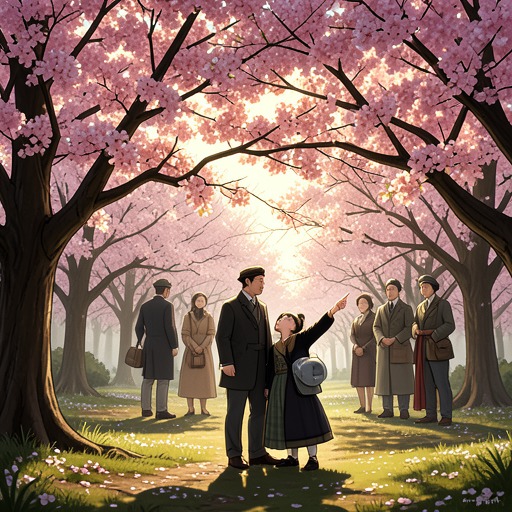
Rie reveals Yuto Makoto Hara's true identity
A ManRié’s disclosure to Yuto about Makoto Hara’s true identity is the point at which a secret about his father becomes something mother and son can face together. She does not simply hand him an explanation: she asks whether he wants to know the whole story, lets him read the lawyer’s written account, and listens as he makes sense of what he has learned. Their conversation changes the family’s names and memories from matters Rié must decide on Yuto’s behalf into questions they can discuss together.
The decision to tell him
Three days after meeting with a lawyer who had investigated his father for more than a year, Rié tells Yuto that she has finally learned why his father changed his name. A document lies face down near her hand; she has been handling and straightening it, while Yuto notices it and asks who his father was. The physical document is the immediate focus of the scene, but Rié’s deeper concern is how much to disclose. Rather than assume that she knows what he can bear, she asks whether he wants everything now or would rather wait.
Yuto first tests what the revelation might mean. He asks whether his father did something wrong, something that could lead the police to take him away. Rié answers that the wrongdoing was the act of changing his name, and points to the lawyer’s account as the place where everything has been written down. Although she warns that he may be shocked and admits that she herself has not fully accepted the account, Yuto chooses to read it. His response is direct: after the deaths of Ryo and his father, he says, there can hardly be anything more shocking. The choice to read is his, even as Rié remains unsure how he will respond.
A name already lived in
The revelation comes against a history of names that Yuto has already explained in his own terms. At birth, the family were the Yonedas; after Rié’s divorce, they became the Takemotos; when he started elementary school, they became the Taniguchis. Now that Rié is considering returning to her maiden name, Yuto says that Taniguchi is the name by which his friends and the older and younger pupils at school know him. Having to correct people repeatedly would make him uncomfortable. A name that Rié can understand as a return to her former family identity has, for Yuto, become the everyday identity attached to his school life.
His objection is also about the father whose identity is now in question. Yuto asks Rié to let him remain Yuto Taniguchi even if she changes her name. He says it would be wrong to do this to his father after that man’s family had turned their backs on him, and worries that changing the name might mean forgetting him too. The scene therefore distinguishes a legal or inherited name from the bond Yuto associates with it: the identity was borrowed, but his attachment to the father he knew is not erased by learning that fact.
Reading, grief, and response
Yuto takes the sheaf of papers to his room and remains there for about an hour. When he returns, he passes the pages to Rié brusquely and says he has read them. For a moment he stands impassively, then starts back toward his room. The account does not make his first reaction a neat resolution; his stillness leaves space between reading the facts and being able to speak about them.
When Rié asks if he is all right, Yuto asks whether his father ever killed anyone. Rié tells him no. He then says that he feels sorry for him, and begins to understand why his father had been so kind to him: perhaps he did for Yuto what he had wanted his own father to do for him. Rié agrees that this is true, but adds that he was also kind because he cared about Yuto. The exchange lets Yuto interpret the father’s affection through the father’s own history without reducing that affection to inherited pain or obligation.
Yuto’s grief becomes openly shared rather than hidden. He apologizes, hangs his head, and cries; Rié cries with him. When she offers a handkerchief, he wipes his face with his palms and looks back at her with red, puffy eyes. His questions and tears do not undo the shock of the account. They show instead that his response includes sorrow for his father, recognition of the care he received, and the need to speak with Rié about what follows.
Family decisions after the revelation
Once he has read the papers, Yuto asks what their surname will be and whether they will become the Haras. Rié suggests Takemoto, which would make them the same as his maternal grandparents again. Yuto gives a slight nod. The exchange does not claim that the name resolves the contradictions in the family’s history. It records a practical decision being considered in conversation, after Yuto has explained why Taniguchi mattered to him and after the truth about his father has become known.
Yuto also returns to the question of his father’s grave, a concern he had raised before the disclosure while asking when Rié would make a grave for the man whose ashes remained in an urn. Rié now proposes that his father be buried in the same grave as Ryo and his grandfather. Yuto agrees, reasoning that then none of them will be lonely. The proposed shared resting place brings several losses into one family decision, without pretending that one death or relationship can simply stand in for another.
The conversation’s final concern is Hana. Rié and Yuto agree that she would not understand the full story if they told her now. Yuto says they have to watch out for her. Rié holds back her renewed urge to cry, meets her son’s eyes, and recognizes how much he has grown. She asks him to promise that he will tell her if he ever needs to talk. The disclosure ends not with every family question settled, but with a reciprocal commitment: Rié gives Yuto a choice about what to know, and Yuto takes part in considering how the family will remember the dead and protect the living.
The child’s way of understanding
Yuto’s response belongs to a larger pattern in which he expresses grief and attachment through both words and acts. When Rié’s mother is unwell, he notices her looking at an aquarium in a shed and asks whether goldfish would be all right, offering to care for them. Rié is moved by his thoughtfulness and remembers that her late husband had also described Yuto as a very thoughtful boy. His care for his grandmother and the goldfish does not replace the conversations he needs with Rié; it makes visible the attentiveness that can coexist with silence.
Rié understands more fully how much he has been carrying when she watches him at a field of flowers. He has lost his brother, grandfather, and the man he believed was his father, yet he remains a boy. She reflects that his reading, looking after Hana, and tending the goldfish may be ways of trying to hold himself together while enduring pain he does not readily express. That perspective helps explain why her disclosure is framed as a choice rather than an announcement: she wants to let him speak and respond, not merely receive the adult account of his family.
Literature gives them another route toward understanding. Rié reads Ryunosuke Akutagawa’s “Asakusa Park,” a story Yuto had mentioned, and is moved by its boy searching for a father after becoming separated from him. She wonders whether the story’s concern with separation had reached Yuto before she told him that the man he knew was not actually Daisuké Taniguchi. She cannot know what he understood in advance, but recognizes that his reading had offered him a way to make an emotional connection visible without stating it plainly. His literary response does not prove foreknowledge of the secret; it shows Rié learning to take seriously the inner life he does not always put into direct speech.
Yuto’s own poem makes that indirect expression especially concrete. In a published acceptance speech, he explains that in Burial Mound Park he saw an abandoned cicada shell stuck to a cherry tree while other cicadas sang in the branches. He imagined how the shell would hear the voice of the body that had lived inside it under the earth for seven years. A crack along the shell’s back reminded him of a violin soundboard, and the shell began to seem to him like a resonating instrument. He does not mention the deaths of his brother or father. Rié nevertheless connects the cherry tree to the one her husband had chosen for himself and imagines Yuto alone beneath it, listening. Whether this was exactly how he composed the poem or a reconstruction, she recognizes that writing has given him a means of coping with loss that she could not have devised for him.
The disclosure’s significance thus lies not only in the information Rié gives Yuto, but in the change in how they meet one another afterward. His surname, his father’s kindness, the proposed grave, and the decision to watch over Hana all become subjects on which he can express a position of his own. Rié cannot remove the accumulated losses or guarantee that he will always speak easily; she can make room for him to read, grieve, disagree, and ask questions. Yuto, in turn, shows that understanding the truth about his father does not cancel his love for the man who raised him.